Project Overview
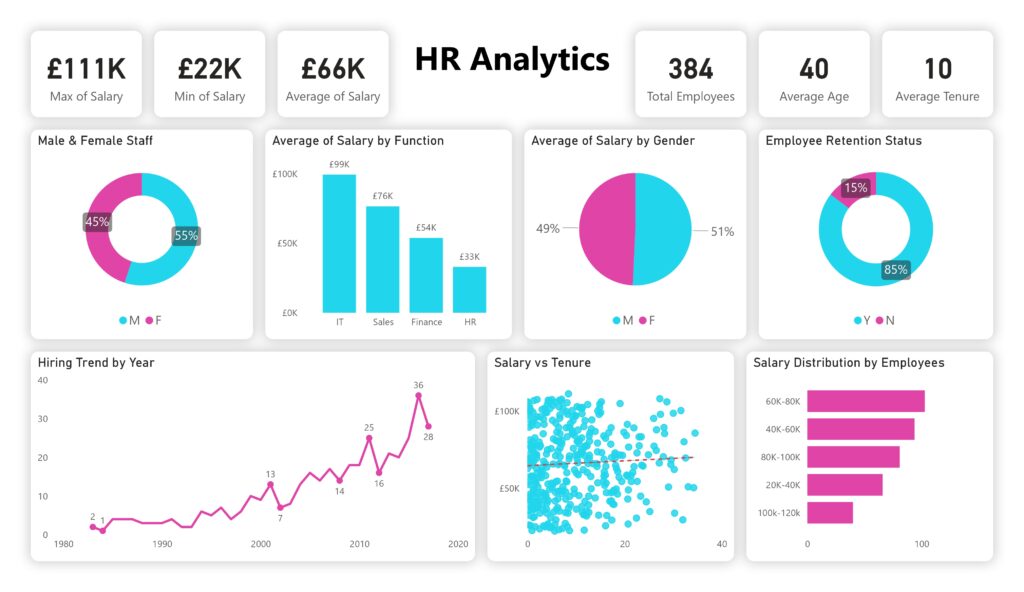
As part of my previous role, I worked closely with HR and senior stakeholders to design and deliver an end-to-end HR analytics dashboard using Power BI, aimed at improving visibility into workforce composition, compensation, hiring trends, and employee retention.
The dashboard was developed to replace fragmented manual reporting with a centralised, interactive reporting solution that could support both operational and strategic HR decision-making.
Business Problem
HR leadership required a clear and consistent view of:
-
Workforce demographics and diversity metrics
-
Salary structures across functions and employee groups
-
Long-term hiring trends and workforce growth
-
Employee retention levels and potential attrition risks
Existing reports were static, time-consuming to maintain, and lacked the ability to explore trends interactively.
Solution Delivered
I designed and implemented a Power BI HR Analytics dashboard that consolidated multiple HR datasets into a single, intuitive interface, enabling stakeholders to explore workforce metrics at both high-level and detailed views.
Key features included:
-
Executive-level KPIs (total employees, average age, tenure, and salary benchmarks)
-
Gender distribution and pay comparison analysis
-
Salary analysis by department and salary band
-
Hiring trends over time to identify growth patterns
-
Retention vs. attrition breakdown to support workforce stability planning
-
Salary vs. tenure analysis to identify progression trends and outliers
Tools & Methods
-
Power BI Desktop
-
Data modeling and transformation
-
DAX measures for KPI calculation and aggregation
-
Interactive visuals and filters for self-service analysis
-
Dashboard design focused on clarity, usability, and stakeholder needs
Impact & Outcomes
-
Provided HR and leadership teams with a single source of truth for workforce reporting
-
Reduced reliance on manual Excel-based reporting
-
Improved visibility into compensation structures and retention levels
-
Enabled faster, data-driven conversations around workforce planning and diversity metrics